How much protein do you need to build muscle?
In short
If you lift weights and want to build muscle, aim for about 1.6 to 2.2 grams of protein per kilogram of body weight per day. At 80 kg that is 128 to 176 g. Below that range you may leave some gain on the table. Above it, studies find little or no extra muscle.
 Cody de LeeuwLast checked 27 October 2026 · 6 min read
How much protein per day?
The research gives a range, not one number. The two main sources agree on the shape of it:
- A 2018 meta-analysis of 49 trials (1,863 people) found that extra protein during weight training added a small amount of muscle and strength. The gains levelled off at about 1.6 g/kg/day. The 95% confidence interval ran from 1.0 to 2.2 g/kg.1
- The International Society of Sports Nutrition says 1.4 to 2.0 g/kg/day is enough for most people who exercise to build or keep muscle.2
The meta-analysis authors point out that because the interval stretched up to 2.2, aiming for about 2.2 g/kg is a sensible way to be sure you are at the top of what helps.1 So a working range is 1.6 to 2.2 g/kg. Use your body weight in kilograms, as it is today.
The effect is not large. Over a typical training block, extra protein added about 0.3 kg of lean mass on average. It matters more for people who already train than for people who just started, and a little less the older you are.1
What does that look like for you?
Multiply your body weight by the two ends of the range. For someone who weighs 80 kg:
| Grams per kg | Calculation | Grams per day |
|---|---|---|
| 1.6 | 80 × 1.6 | 128 g |
| 2.0 | 80 × 2.0 | 160 g |
| 2.2 | 80 × 2.2 | 176 g |
Anywhere between 128 and 176 g is inside the range. Pick a number you can hit most days. Missing it by 10 g on a Tuesday changes nothing. What counts is what you eat on average over weeks.
Does it matter how you spread it over the day?
A little. The usual advice is to split your protein over three to five meals instead of eating most of it at dinner. The position stand suggests about 0.25 g/kg per meal, or 20 to 40 g, roughly every 3 to 4 hours.2 A 2018 review landed on 0.4 g/kg per meal over at least four meals.3 For 80 kg that is 20 to 32 g per meal.
Do not treat those numbers as a hard cap per meal. Older studies suggested that the body can only use 20 to 25 g at once. A 2023 lab study gave young men either 25 g or 100 g of protein after training. The 100 g dose led to a bigger and longer muscle-building response, still going after 12 hours.4 That was a small, controlled study, so it shows that a big meal is not wasted. It does not show that it is better.
In practice: if your daily total is right, spread it in a way that fits your day. Three or four meals with a decent portion of protein each is easy to keep up.
Which foods count as protein-rich?
Animal foods such as meat, fish, eggs and dairy contain all the essential amino acids. So do soy foods such as tofu. Beans and lentils have less protein per portion, and you need more of them for the same amount. All foods with protein count towards your total. Here are some examples:
| Food | Protein per 100 g |
|---|---|
| Chicken breast, skinless, raw | 22.5 g |
| Salmon, farmed, raw | 20.4 g |
| Tofu, firm, raw | 17.3 g |
| Egg, whole, raw | 12.6 g |
| Greek yoghurt, plain, low-fat | 10 g |
| Lentils, boiled | 9 g |
These are raw weights for meat, fish and tofu, so cooked portions weigh less and contain a bit more protein per 100 g. Packaging varies by brand, so check the label.5
A day that adds up to roughly the 80 kg example: 250 g Greek yoghurt (25 g), 150 g chicken breast (34 g), three eggs (19 g), 200 g salmon (41 g) and 150 g tofu (26 g) make 145 g. Bread, oats, rice and vegetables add more on top.
Is more always better?
No. In the meta-analysis, intakes above about 1.6 g/kg/day gave no further gains in lean mass.1 Going from 1.2 to 1.8 g/kg is worth the effort. Going from 2.2 to 3.0 mostly adds work: more chicken, more shakes and a bigger bill.
Protein also takes up room in your calorie budget. Each gram is 4 kcal, so every extra gram you eat leaves less room for carbohydrates and fat. Carbohydrates in particular fuel hard sessions. Set your protein, then fill the rest of your calories around it.
If you have a medical condition, or you are pregnant, ask a doctor or dietitian what is right for you before you change how much protein you eat.
Moderate evidence
A meta-analysis of 49 randomised trials shows that extra protein adds a little muscle and strength during weight training. The exact point where more stops helping is fuzzy: the estimate is 1.6 g/kg with a wide confidence interval, and the position stand gives a slightly lower range of 1.4 to 2.0. How we rate evidence

How Mitta does it
A protein target from your body weight.
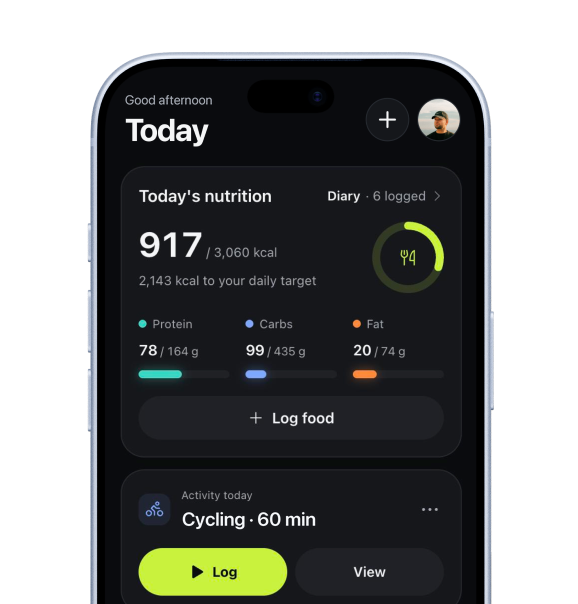
Mitta sets your protein target as grams per kilogram of your body weight, and shows the sum behind it. You can change the number yourself.
- 2.0 g per kgYour starting protein target is your weight times 2.0 g. At 80 kg that is 160 g. If your goal is losing fat, it is 2.2 g per kg.
- Carbs fill the restAt the start, fat is 0.9 g per kg and carbohydrates take what is left of your calorie target.
- A tick per mealIn your food log, a meal gets a tick when it has at least 0.3 g of protein per kg of body weight. From age 50 the minimum is 25 g.
- Your callIn your daily targets, the suggestion has a “Why?” that shows the grams per kg behind it. You can set your own protein number there.
Know where your protein stands.
Mitta sets a protein target, shows how it got there and tracks it as you eat. Free to start, in the web app for invited testers.
Questions about
How much protein do you need to build muscle
Do I need protein shakes?
No. A shake is just a convenient source. Food counts the same, and the position stand recommends whole foods first. Use a shake if it helps you reach your number.
Do I have to eat protein right after training?
No. The position stand says protein before or after a session both work, so timing is mostly personal preference. Your daily total matters more.
Is a vegetarian or vegan diet enough?
It can be. Soy foods, beans, lentils, dairy and eggs all contribute. Plant foods tend to have less protein per portion, so you may need to plan a little more to reach the same total.
Should I use my current weight or my goal weight?
Use your current body weight. The studies above express protein per kg of body weight as it is, so that is what the range refers to.
Sources
- Morton RW, Murphy KT, McKellar SR, Schoenfeld BJ, Henselmans M, Helms E, et al. A systematic review, meta-analysis and meta-regression of the effect of protein supplementation on resistance training-induced gains in muscle mass and strength in healthy adults. British Journal of Sports Medicine, 2018; 52(6): 376–384. doi.org/10.1136/bjsports-2017-097608
- Jäger R, Kerksick CM, Campbell BI, et al. International Society of Sports Nutrition position stand: protein and exercise. Journal of the International Society of Sports Nutrition, 2017; 14: 20. doi.org/10.1186/s12970-017-0177-8
- Schoenfeld BJ, Aragon AA. How much protein can the body use in a single meal for muscle-building? Implications for daily protein distribution. Journal of the International Society of Sports Nutrition, 2018; 15: 10. doi.org/10.1186/s12970-018-0215-1
- Trommelen J, van Lieshout GAA, Nyakayiru J, et al. The anabolic response to protein ingestion during recovery from exercise has no upper limit in magnitude and duration in vivo in humans. Cell Reports Medicine, 2023; 4(12): 101324. doi.org/10.1016/j.xcrm.2023.101324
- U.S. Department of Agriculture, Agricultural Research Service. FoodData Central, SR Legacy database. 2019. fdc.nal.usda.gov/
Written by Cody de Leeuw. First published 27 October 2026, last checked 27 October 2026. This article is general information, not medical advice. Spotted a mistake? Tell me