How to read a nutrition label
In short
Find the column you need: per 100 g or 100 ml (always on EU and UK labels) or per serving (on US labels). Use kcal, not kJ. Then multiply by the amount you really ate. Watch for two differences between Europe and the US: European carbohydrate figures leave out fibre while American ones include it, and Europe lists salt where the US lists sodium.
 Cody de LeeuwLast checked 29 October 2026 · 5 min read
European and UK labels
Labels in the EU and the UK follow the same rules.1 They must show, per 100 g or 100 ml:
- Energy, in kJ and kcal
- Fat, and of which saturates
- Carbohydrate, and of which sugars
- Protein
- Salt
Fibre is often listed too, but separately: it is not part of the carbohydrate figure. Many packs also show values per portion, but the per-100 g column is the one you can always compare.
American labels
The US Nutrition Facts label works per serving.2 Start with the serving size at the top and check how many servings you actually had. Total carbohydrate on a US label includes fibre, and sodium is listed in milligrams. The % Daily Value compares a nutrient with a 2,000-calorie reference diet.
The differences that trip people up
| EU and UK | US | |
|---|---|---|
| Main column | Per 100 g or 100 ml | Per serving |
| Energy | kJ and kcal | Calories (kcal) |
| Carbohydrate | Without fibre | Including fibre |
| Salt | Salt (g) | Sodium (mg) |
- kJ to kcal: divide kJ by 4.184.
- Sodium to salt: salt is about sodium × 2.5. So 400 mg of sodium is about 1 g of salt.
Log what you really ate
A pack of 400 g with 120 kcal per 100 g has 480 kcal in it. If you ate half, that is 240 kcal. When a label works per serving, check whether your serving matches theirs: a "serving" of cereal is often smaller than a normal bowl.
How Mitta does it
Point at a label. Skip the maths.
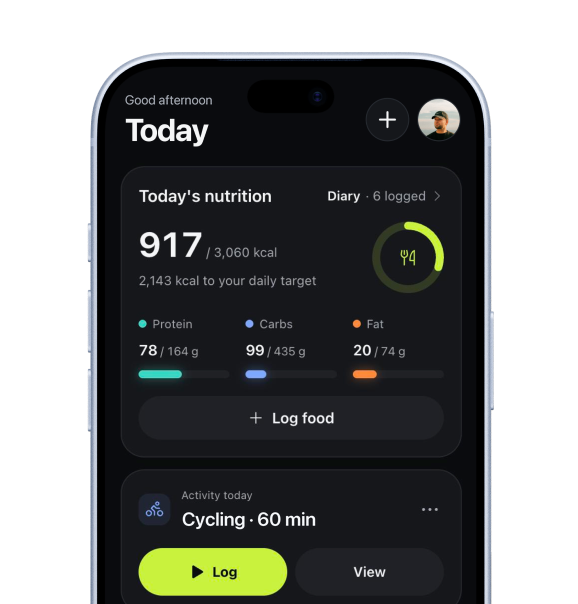
With Pro + AI, take a photo of a nutrition label and Mitta reads the values for you. Without AI you type them in yourself.
- You check the numbersMitta shows the values it read before anything is saved, so you can correct them.
- Log the portion you ateEnter how many grams you had and Mitta does the sum.
- Or scan the barcodeMost packaged foods are found by barcode for free, with values from the food databases.
Log packaged food in seconds.
Scan the barcode or read the label, then log the portion you ate. Free to start, in the web app for invited testers.
Questions about
How to read a nutrition label
Should I use kJ or kcal?
Either works, as long as you are consistent. Most apps and food targets use kcal. To convert, divide kJ by 4.184.
Why do the carbs differ between a European and an American label?
European labels leave fibre out of the carbohydrate figure; American labels include it in total carbohydrate. The food is the same, the counting is different.
How do I turn sodium into salt?
Multiply by 2.5. So 400 mg of sodium is about 1 g of salt.
Per 100 g or per portion: which should I use?
Per 100 g, because you can then weigh or estimate what you really ate. Portion sizes on packs are often smaller than what people eat.
Sources
- Regulation (EU) No 1169/2011 of the European Parliament and of the Council on the provision of food information to consumers. Official Journal of the European Union, 2011; L 304: 18–63. eur-lex.europa.eu/eli/reg/2011/1169/oj
- U.S. Food and Drug Administration. How to understand and use the Nutrition Facts label. www.fda.gov/food/nutrition-facts-label/how-understand-and-use-nutrition-facts-label
Written by Cody de Leeuw. First published 29 October 2026, last checked 29 October 2026. This article is general information, not medical advice. Spotted a mistake? Tell me