Should you eat more on training days?
In short
You can, but you do not have to. For building muscle or losing fat, what you eat over the whole week matters more than how it is spread. Moving some carbs from rest days to training days can make hard sessions feel better and rest days feel lighter. Keep protein the same every day.
 Cody de LeeuwLast checked 29 October 2026 · 5 min read
The weekly total comes first
Whether you gain, lose or keep your weight depends on your average intake over time. One bigger day and one smaller day balance out. So shifting food between days is a question of comfort and performance, not of results on the scale.
Why carbs, and not protein or fat?
Carbohydrates are the fuel that hard training uses most. Sports nutrition guidelines scale carbs to the amount of training:1
| Training load | Carbs per kg of body weight |
|---|---|
| Light, low intensity | 3 to 5 g |
| Moderate, about an hour a day | 5 to 7 g |
| High, 1 to 3 hours a day | 6 to 10 g |
Those ranges come mostly from endurance sport. For lifting, a review suggests that 3 to 7 g per kg is the usual advice, but that lifters may need less than that, because a weight session rarely empties your carb stores.2
Protein is different. Your muscles keep rebuilding on rest days, so keep protein the same every day.
How to do it
If you want to try it, keep it simple:
- Start from your normal daily calorie and carb target.
- Add 10 to 20% more carbs on training days.
- Take the same amount back, spread over your rest days, so the week adds up.
- Keep protein and fat the same every day.
With 250 g of carbs a day and three training days, that could be about 290 g on training days and 220 g on the four rest days.
Who it suits
It tends to suit people who train hard, have long sessions or do cardio and sports next to lifting. It suits people less if a changing target makes eating stressful. A flat target that you hit most days beats a clever one that you skip.
Weak evidence
Sports nutrition guidelines link carbohydrate needs to how much you train, but few studies have compared eating more on lifting days with eating the same every day. Most of the advice here is reasoning from related research. How we rate evidence

How Mitta does it
Targets that move with your training.
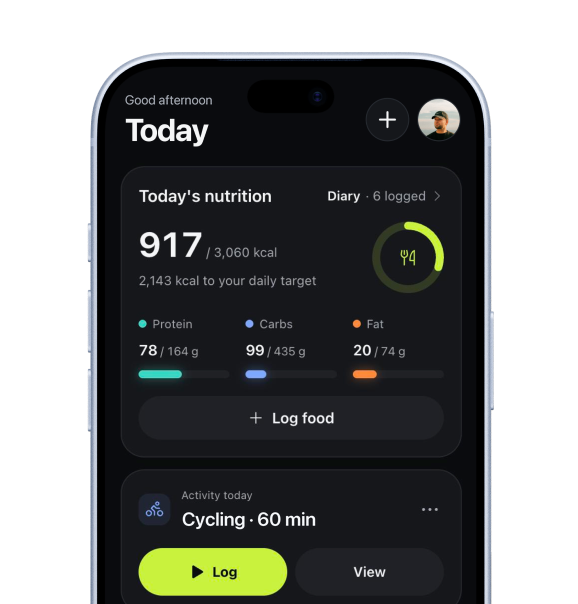
In Mitta, your carbs can move with your plan: a bit more on strength days, a bit less on rest days, with the week still adding up to your target.
- 15% more on strength daysOn a day with strength training, your carb target goes up by 15%. Protein and fat stay the same.
- Rest days give it backYour rest days share the difference, so your weekly average stays on target.
- Never below the floorA rest day never drops below the safe calorie floor. You can turn the shift off and keep a flat target.
Eat for the day you’re having.
Mitta moves your carbs with your training and keeps the week on target. Free to start, in the web app for invited testers.
Questions about
Should you eat more on training days
Is carb cycling better for fat loss?
There is no good evidence that it is. Fat loss depends on your average intake over time. Carb cycling can help if it makes your diet easier to stick to.
Should I eat less on rest days?
Only if you move that food to your training days. Eating less on rest days without adding it elsewhere just lowers your weekly total.
Should protein change on rest days?
No. Muscle repair goes on after training, so keep protein about the same every day.
What about days with cardio or sports?
Long or hard sessions use more carbs, so those days are good candidates for more food too. Short, easy sessions change little.
Sources
- Thomas DT, Erdman KA, Burke LM. American College of Sports Medicine joint position statement: nutrition and athletic performance. Medicine & Science in Sports & Exercise, 2016; 48(3): 543–568. doi.org/10.1249/MSS.0000000000000852
- Escobar KA, VanDusseldorp TA, Kerksick CM. Carbohydrate intake and resistance-based exercise: are current recommendations reflective of actual need? British Journal of Nutrition, 2016; 116(12): 2053–2065. doi.org/10.1017/S0007114516003949
Written by Cody de Leeuw. First published 29 October 2026, last checked 29 October 2026. This article is general information, not medical advice. Spotted a mistake? Tell me